The message from Dhaka came before dinner, while Zayan was between work and dinner and Dhaka was getting ready for bed.
Zayan Rahman was at his small kitchen table with a half-finished mug of tea, a laptop still open beside him, and Miso watching from the chair opposite. His parents usually called on Fridays. Between calls they sent smaller things: a photograph of a repaired balcony railing, a reminder to eat properly, a question about whether Germany was still cold, a picture of fruit from the market.
This message was shorter.
His mother wrote first: Can you talk? Then his father called.
Laila was gone.
For a few seconds Zayan did not answer. He looked at the phone and then at Miso, who had put one paw on the edge of the table and was considering whether the rules of the apartment still applied.
"Zayan?" his father said. "Can you hear me?"
"Yes," Zayan said. "I can hear you."
Laila had never officially been his cat. That was part of the problem. She had arrived at the Rahman family's gate in Dhanmondi as a skinny orange stray with watchful eyes and the confidence of someone who had already decided where she belonged. Zayan had given her food once, then again, then too often for the family to keep pretending that she was only passing through.
She waited near the front step after rain. She followed him in the courtyard when he came home from work. She sat nearby when he brought his laptop outside in the evenings, before the mosquitoes became too determined. When he moved to Bonn, he asked his parents for photos. They sent them irregularly, as parents do: Laila near the gate, Laila under the plants, Laila looking offended by a bowl that had been placed slightly too far from her preferred spot.
Now there would be no new photos.
His mother told him the practical details. She had not suffered long. A neighbour had helped. They had buried her near the back wall, where the afternoon sun reached the ground.
Zayan thanked them. He did not know what else to do from Germany.
After the call, he stayed at the table. Miso jumped up at last, ignored the laptop, and settled beside his arm.
"You would not have liked her," Zayan said.
Miso blinked slowly.
"She was very confident."
Before Bonn, Zayan's life had looked orderly from the outside: good student, computer science degree from BRAC University, stable job in a bank, parents who could tell relatives that their son worked in technology. The bank job was in the credit card issuance department. It sounded more modern than it felt.
Most days, Zayan supported the machines and programs that kept cards moving through the system. He checked logs, fixed failures, followed procedures, watched processes run, documented small incidents, waited for approvals. When something needed changing, it moved through layers of caution. The bank had reasons for that. Money, identity, customer records, compliance: none of it could be treated casually.
Still, he felt the narrowness of it.
He liked building. He liked the moment when a messy process became a clear screen, a clean data flow, a tool that made people less dependent on memory and spreadsheets and hurried calls. At the bank, he was allowed to do some software development from time to time, but the freedom was thin. A small script could require a long conversation. An improvement could be treated as a risk before anyone saw it as a possibility.
"You are learning discipline," his father told him once.
"I am learning patience," Zayan said.
"Same thing, when you are young."
His father was not wrong. The bank taught Zayan to respect systems that could not fail at 4 p.m. because someone had been clever at 10 a.m. It taught him to read consequences before writing code. It taught him that boring work is often boring because people depend on it.
It also made him restless. He was young, and the bank already felt like a ceiling. He wanted to make more of the choices, not only support the choices already made by someone else. He wanted a project he could point to and say, without a long explanation, that it had changed something outside an internal queue.
When a local UNDP consultancy opened for a software role connected to textile production oversight and environmental compliance, Zayan read the description three times.
He knew the world behind those words. Garment factories were everywhere in Bangladesh. So were water, waste, compliance, pressure from buyers, pressure on workers, pressure on regulators, and pressure on anyone trying to say what was actually happening inside a production chain. The vacancy gave a name to problems he had seen around him for years.
The compensation was lower than the bank.
His mother noticed that first.
"Lower?" she said.
"Yes."
"And temporary?"
"Consultant."
"That means temporary."
"It means consultant."
"Zayan."
He smiled because she was right and because he had no better defence.
His parents did not forbid him. They asked ordinary questions, which were harder to answer than dramatic ones. Would the contract be renewed? Would he have health coverage? Would this help him later? Was he sure the UN name was not making him romantic about a worse job?
"I will build something people use," he said.
His father looked at him for a moment.
"At the bank, people also use what you fix."
"They use it to issue cards."
"Cards are also important."
"I know."
That was the difficult part. He was leaving a sensible job because another kind of work had started to feel necessary.
The UNDP project came with factory records that did not agree with one another, environmental indicators that people described differently depending on who was in the room, and users who needed a system that worked even when the internet did not behave. It had spreadsheets with too many colours. It had inspection notes that made sense to the inspector and nobody else. It had meetings where people used the same word to mean three different things.
Zayan liked it.
He liked that the mess was real. A production site either had a record or did not. A water sample had a number. An effluent treatment plant had an inspection history. A dashboard could not solve environmental compliance by itself, but it could make evasion harder and oversight less dependent on personal memory.
He built carefully. Factory profiles. Production entries. Environmental indicators. Uploads for inspection documents. A dashboard that let programme staff see which sites needed attention. Basic alerts. Exportable reports. People could use it.
The first time a UNDP colleague used the system in a meeting without asking him to explain it, Zayan felt a satisfaction the bank had never given him. The software had left his hands and become part of someone else's work.
He remembered that feeling when he saw the Bonn vacancy.
The P-2 post in Bonn arrived as vacancies usually do: requirements, deadlines, forms, and phrases that sounded both exciting and dry. Associate Information Systems Officer. UNCCD Secretariat. Data reporting. Support to Parties. Digital systems for a global environmental mandate.
He almost did not apply.
The job looked slightly too far away from him. The technical side made sense. The institution was the intimidating part. He had never been international staff. He had never lived in Europe. He had a local degree, a bank job, and a UNDP consultancy. He knew how to build systems, but recruitment pages have a way of making people feel smaller than their actual experience.
His UNDP supervisor told him to apply.
"You have the story," she said.
"Everyone has a story."
"Not everyone has delivered the system."
So he applied. He wrote about the bank as proof that he could handle systems where mistakes had consequences. He wrote about the textile platform as proof that he could build for people outside a software team. He wrote about reporting as a way for institutions to act on facts. He did not pretend to be a policy officer. He let the engineering carry the application.
Months later, he was in Bonn, learning the route from his apartment to the office and keeping a folder of immigration papers, tenancy papers and bank letters on his desk.
The UNCCD office gave him a different kind of responsibility. The users were not bank staff or a project team in Dhaka. They were national focal points and reporting teams trying to submit data for an international convention. A broken workflow could delay more than a task. A confusing form could turn into bad data. A poor design choice could make reporting harder for the very people the system was meant to support.
Zayan had more freedom now. It came with more trust, and with consequences he could see more clearly.
In meetings, Zayan was close enough to the discussion to understand why a reporting problem mattered before he started turning it into software. Programme colleagues argued about what Parties needed, and he translated that into fields, validation, imports, exports, guidance text, error messages and release plans. When someone asked whether the system could show where data was missing, a report spec was already forming in his head: missing fields, country filters, submission status, last update, export.
At his new home, in the Bonn apartment, life eventually returned to ordinary size. Miso wanted food. The laundry needed doing. His mother wanted to know whether he had bought a proper winter coat. His father wanted photos of the bicycle path because he had decided, from Dhaka, that cycling in Germany was both healthy and dangerous.
"Wear the helmet," his father said.
"I wear the helmet."
"Send proof."
Zayan sent a photo of the helmet on the table.
"On your head," his father wrote back.
Most days, the distance was a schedule problem: time zones, calls, tiredness, the awkward delay before a video call becomes natural. Some days it was food. Some days it was language, because English at work and German in shops did not replace Bengali at home. Some days it was the knowledge that his parents were getting older in the flat where he still knew every cupboard handle and uneven tile.
And then there was Laila.
He knew that a stray cat in Dhaka was not a promise. He knew that affection did not make a city gentle. Still, when the news came by phone, it felt unfair in a way he could not explain without sounding childish.
The next morning, he went to the office early.
There was a reporting issue waiting. A data import had failed for a small reason that could become troublesome if left alone. Zayan read the logs, checked the mapping, found the brittle assumption, and fixed it before the morning had properly begun.
By ten, the system was working.
By noon, someone from another team sent a short message: "Thanks, this helps."
He looked at the message longer than it required.
The work had pulled him a long way from home. Some days that felt like a prize. Some days it simply felt far from home.
Late the next afternoon, he left the office early enough to catch his parents before bed. His mother told him she had found one more photo of Laila, taken near the gate after rain. In the picture, the concrete was dark, the plants were too green, and Laila was looking away from the camera as if someone had called her name from the street.
"Send it," Zayan said.
"I already sent it."
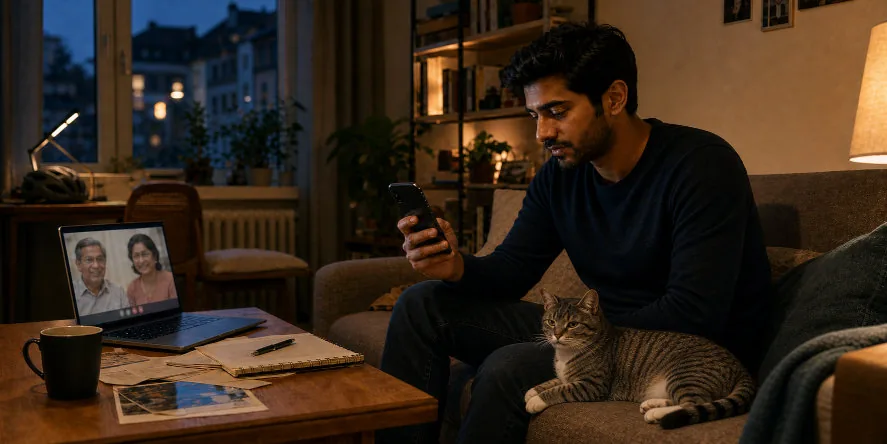
He opened the message while they were still on the call. Miso climbed onto the sofa beside him and pressed against his leg.
"She looks good there," his father said.
"Yes," Zayan said. "She does."
For a while nobody spoke. On the screen, his parents sat close together, waiting for him to say something. In Bonn, Miso had settled against his leg and refused to move.
Zayan had no clever sentence for any of it. He was in Bonn because the work had pulled him there. His parents were in Dhaka. Laila was in the photo. Miso was warm against his leg.
He sat with that for a while. Then he saved the photo, checked the morning's calendar, and let Miso stay pressed against his leg a little longer.