At the career office in Bogotá, Sofía Álvarez learned to recognize a particular pause. A student would come in with good grades, careful notes, and a question that was not really a question.
"Do you think someone like me can apply?"
"Someone like me" could mean many things. Someone whose parents had not studied abroad. Someone whose English was good but not elegant. Someone who had never written a motivation letter to an international programme. Someone who knew how to work hard, but not how to sound as if the world had always expected them to enter the room.
Sofía was young enough then to answer too quickly.
"Of course," she would say.
Then she learned that "of course" was only the beginning.
The student still needed to understand the form. The deadline. The references. The tone. The difference between modesty and invisibility. The way a local internship could be described so an international reader would see responsibility rather than only assistance. The way a scholarship application could ask for "leadership" and make a perfectly capable person think of presidents, not of the year they had kept a student association alive with no money and too many opinions.
Sofía had come to Universidad de los Andes on the serious kind of hope: scholarship forms, family pride, pressure that nobody meant to add and everyone added anyway. She knew what it was to study in rooms where some people seemed to understand the hidden rules before the teacher had spoken.
She did not make a speech about it. That was not her style. She made lists, rewrote sentences, asked students to say out loud what they had actually done, and then made them write it down without apologising for it.
"You coordinated the project," she told one student.
"I helped."
"Who sent the emails?"
"I did."
"Who called the school?"
"I did."
"Who prepared the budget?"
"I did."
"Then write that."
The student laughed, embarrassed.
"It sounds too much."
"It's accurate."
That was where Sofía's career began: at a desk far from any grand international office, with appointment slots, draft letters, scholarship forms, and people who arrived carrying more ability than confidence.
When she moved to Madrid for her master's degree, the same questions became personal again. She arrived with two suitcases, Spanish that suddenly sounded Colombian in every room, and English she could use well enough but still had to sharpen for readings, seminars, and international classmates. Human resource management and organisational psychology sounded like an academic choice. In practice, it became a study of how people find their way into institutions, how they learn the rules once inside, and how differently those rules can work for different people.
Madrid was generous to her in some ways and sharp in others. She loved the city before she fully understood it. She learned which offices closed earlier than expected, which documents needed a copy of a copy, how to read a rental contract with suspicion, and how to stop feeling personally insulted by bureaucracy.
She met Javier Moreno through friends during one of his visits back to Madrid from London. A small group had arranged to meet near the university, and Javier proposed the cafeteria because it was easy for everyone. Sofía later teased him that he had really chosen it because the tables were big enough to spread out an economics article.
"You always look as if the data disappointed you," she told him the third time they met.
Javier looked up, considered this, and smiled.
"Often it has."
He was from Madrid, calm, analytical, careful with words in a way that could either soothe her or make her impatient. Sofía liked that he did not pretend to be more certain than he was. Javier liked that she could walk into a room and make people speak more honestly than they had planned.
Their first arguments were not really arguments. They were differences in professional temperament dressed as conversation.
Sofía believed people often needed a push before the opportunity looked possible.
Javier believed the push should come after the risks had been named.
"If you name all the risks first, people never move," she said.
"If you do not name them, they move badly," he said.
"That sounds like something written by a committee."
"Some committees are right."
She groaned. He laughed. The relationship survived.
By the time Bonn entered the story, Sofía had stopped imagining an international career as a clean upward line. It was more like a series of rooms, each with its own badge, vocabulary, contract type, salary scale, acronyms, and quiet tests of belonging.
UN Volunteers made sense to her for that reason.
The organisation dealt with people who already had strong international profiles, and with people still trying to find their first real opening. It worked with assignments, volunteers, rosters, deployment, recruitment, and the practical machinery that turns willingness into service. For many people, a UN Volunteer assignment is more than a decorative line on a CV. It is the first time the international system becomes real enough to touch.
Sofía's work in Bonn sat close to that machinery. Recruitment operations and volunteer deployment management did not sound glamorous at dinner parties. She did not mind. She had seen what happened when a person who could do the work never found the entrance.
In UNV, the entrance was never one thing. It was eligibility, timing, nationality, language, assignment terms, availability, family situation, supervisor needs, funding, security clearance, medical clearance, and sometimes sheer patience. A country office could need a profile clarified before a deployment window closed. A candidate could be technically eligible but unavailable for the dates that mattered. A small roster note could decide whether someone appeared in the right search at all.
Sofía respected the system more than she had expected to.
She also argued with it in her head almost daily.
That contradiction suited her. She had never been against rules. She was against rules pretending not to have consequences for different people.
At home, those consequences had a smaller, noisier shape.
Lucía was still young enough to treat Bonn as the natural order of the world. The Rhine, the playground, daycare shoes, German words that appeared at breakfast without warning, Javier's policy papers on the kitchen table, Sofía's work calls from the corner of the apartment, video calls with Bogotá and Madrid that always began with adults asking whether Lucía had grown.
"She has learned a new word," Javier said one evening.
"Which language?"
"That is the question."
Lucía had pointed at her shoes and produced something that sounded German, Spanish and toddler at the same time.
Sofía repeated it.
Lucía corrected her with great seriousness.
Javier leaned back. "We are losing authority."
"We never had it," Sofía said.
Their life in Bonn was not the glossy version of an international family. It was rent, daycare schedules, train delays, two careers, one small child, grandparents on screens, and the constant arithmetic of time. Still, a UN post changed some of that arithmetic. Sofía had become practical about things she had once considered too unromantic to mention: salary scales, family status, school costs, travel home. With Lucía, the higher pay rate for staff with recognised dependants was no longer just a line in a benefits table. The education grant - UN's assistance for education of children of international staff - would matter later. Home leave was not a vague perk either; once every other year, it could make Colombia realistically reachable as a family trip. Spain was close enough for a cheap weekend from Bonn. Bogotá was not. She did not think a benefits package made a career meaningful. She did think stability had moral value when a family was trying to build a life across borders.
That was one reason she was careful with candidates. A move was never only a move. It could be a spouse leaving work, a child changing language, a parent ageing far away, a rent contract broken, a passport renewed, a savings account emptied, a grandparent's birthday missed, a new country becoming home before anyone had agreed to call it that.
In the office, people spoke of assignments. At home, Sofía knew they were also speaking of households.
This made her better at her work and occasionally worse at relaxing.
Javier noticed.
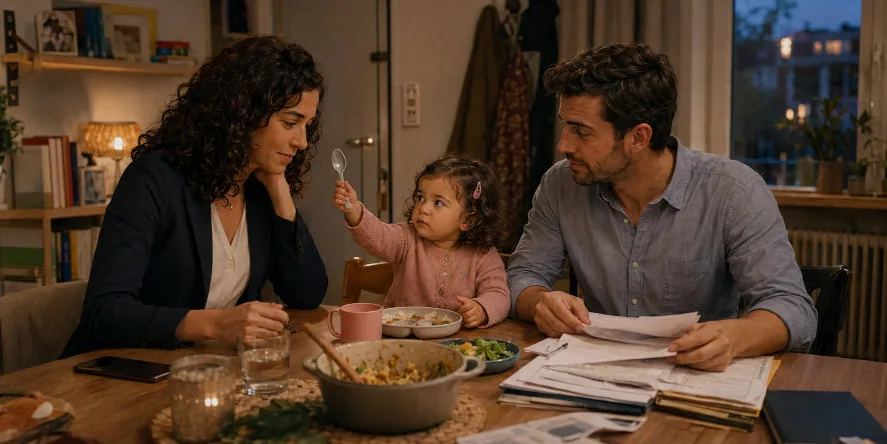
“You are still thinking about the deployment case,” Javier said one evening.
“I am not.”
“You have been reading the same message for three minutes.”
Sofía looked down at her phone, which she had meant only to move away from Lucía’s spoon.
“Fine,” she said. “I am thinking about it.”
“Can you solve it tonight?”
“No.”
“Then leave it there for tonight.”
She put the phone face down beside the salt. Javier did not look triumphant, which was one of his more irritating habits. He simply passed her the salad and returned to telling Lucía that no, rice was not improved by dropping it into a glass of water.
The next week, she met Zayan Rahman for lunch.
They had seen each other around the Bonn UN orbit: meetings, introductions, the polite recognition of people whose work touched the same institutional city from different angles. Zayan was at UNCCD, a P-2 Associate Information Systems Officer from Bangladesh, building reporting systems for Parties to the Convention. He was quiet in groups, precise when he spoke, and more observant than people first assumed.
They chose a simple place near the office because neither of them had much time. Zayan arrived with the punctuality of someone who had left early to avoid being late.
"I still think somebody made a mistake," he said after they had ordered.
Sofía did not pretend not to understand.
"With your post?"
He nodded.
"The application made sense when I sent it. Then the interviews made sense while they were happening. Now I am here, and sometimes I think, how did this become my life?"
She smiled, but not too brightly.
"That feeling is more common than people admit."
"At the bank, I understood the next step," he said. "Here, I understand the work, but not the career."
That was honest enough to deserve a practical answer.
"You spend so much energy getting in," Sofía said, "and then nobody gives you a map for what comes after."
Zayan looked relieved and annoyed by the relief.
"So this is normal?"
"Normal, yes. Comfortable, no."
He laughed softly.
“Good,” Zayan said. “That helps almost not at all.”
They talked for a few minutes about what he had actually done: bank systems in Dhaka, the UNDP textile compliance platform, the Bonn reporting work. Sofía asked questions the way she had learned to ask them years earlier in the career office, except now the person across the table had already crossed a continent.
"Do not rush the next label," she told him. "First see what this post is teaching you."
Zayan smiled a little. He did not yet know what to do with that advice, but he knew he would remember it.
She did not mention platforms or tools until the end, and even then only lightly. Some candidates were arriving better prepared now, she said. They had compared themselves to real vacancies, understood their gaps, and stopped treating international applications as pure luck. She liked seeing that. Anything that helped people arrive with better questions was useful.
Zayan nodded as if the phrase had landed somewhere familiar.
"The questions are the hard part," he said.
"The good ones usually are," Sofía said.
After lunch, she went for a short walk through the Rheinaue - she had ten minutes to spare before her next meeting. Bonn was doing its usual quiet ambience trick: making international work look ordinary. People exercised in the park. Someone pushed a stroller. Two people with badges passed by passionately arguing about a document. The Rhine was nearby, moving ahead without needing anyone's signature.
Sofía thought of the students in Bogotá who had asked whether people like them could apply. She thought of Madrid, of Javier at a cafeteria table looking at an economics article as if the numbers had let him down, and of Lucía correcting her parents in a language she had not yet fully invented. She thought of Zayan, who had made it to Bonn and was still learning what kind of life this new post could give him.
That evening, Lucía refused dinner for reasons known only to herself, Javier found a missing daycare form under a stack of policy notes, and Sofía answered one last message before putting her phone away.
"You are back?" Javier asked.
"Almost," she said.
Lucía held up a spoon as if chairing the discussion.
Sofía took it from her, kissed the top of her head, and sat down.
For the moment, that was enough: Bonn, dinner, a child inventing rules, work waiting until morning, and a life that was complicated and possible at the same time.