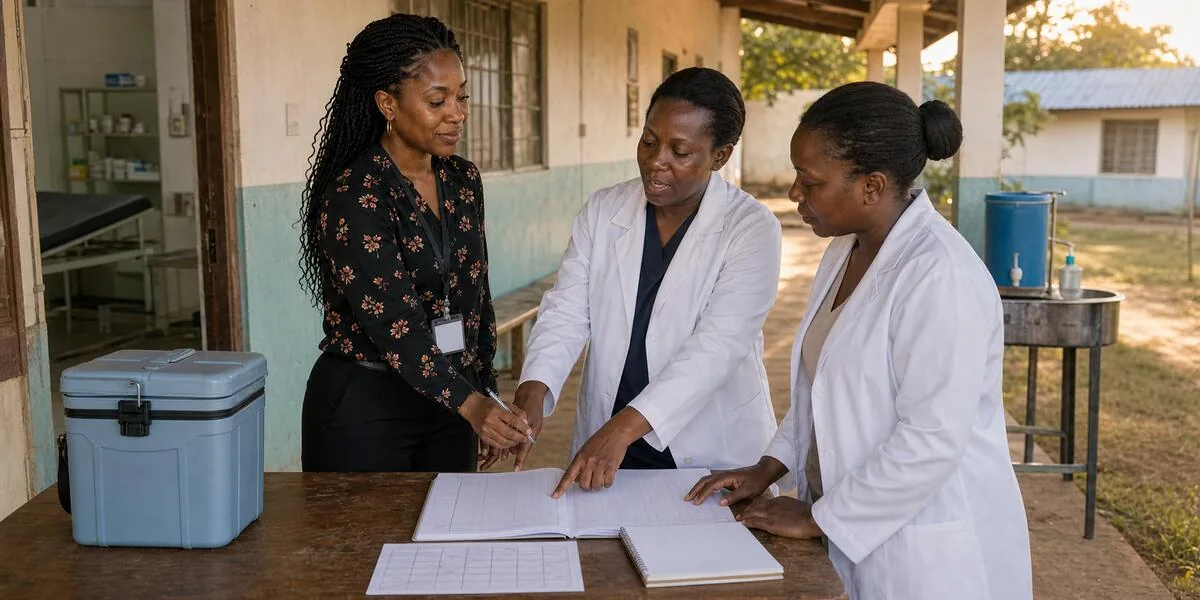
Esther Nansubuga was seven when the vaccination team came through her village outside Masaka.
It was 1996, the year Uganda began nationwide polio vaccination days. The health workers arrived with vaccine carriers and lists of children under five. Mothers brought babies. Older children followed to watch. Esther stood close enough to see her young cousin prepare himself for an injection, then look almost offended when the health worker opened his mouth and gave him two drops instead.
By lunchtime, nearly every small child Esther knew had been called forward.
The campaign belonged to Uganda's Ministry of Health, with support from the World Health Organization and UNICEF. Esther did not know how those institutions fitted together. She saw Ugandan health workers moving from family to family and a vaccine reaching children who had never been near a large hospital.
She had already said that she wanted to become a doctor. It was the most serious and useful job she could imagine. The vaccination day made the job seem ever larger. The nurses administered vaccines that could protect an entire village before anyone became ill.
The road from that village to medical school depended on excellent marks and a great deal of family arithmetic.
Esther's family grew food and kept a small number of cattle. The animals covered the expenses that could not wait: treatment, school fees, repairs and a difficult season. When Esther earned a place at a strong boarding school in Kampala, her father and uncle each sold cattle to cover what the family could not meet from ordinary income.
She knew what had paid for the opportunity. Each holiday when she came to visit, the herd was smaller.
Kampala was noisy, crowded and full of students who understood city life better than she did. Esther learned it quickly. She was good at biology and chemistry, disciplined in the laboratory and calm in examinations. By the time she applied to Makerere University, medicine no longer felt like a childhood answer to an adult question. She knew what the training involved and wanted it anyway.
Makerere admitted her to its five-year Bachelor of Medicine and Bachelor of Surgery programme. The admission did not come with enough financial support to make the decision easy. Her father and uncle sold most of the cattle they still owned.
Her father did not ask her to carry the sacrifice around as guilt.
"Your work is to finish," he told her.
She did.
Medical school replaced the clean diagrams of secondary-school biology with wards, night work, relatives frightened my the youthfulness of the wannabe doctors as much as by the illness of their loved ones, and patients whose illnesses had often travelled too far before reaching a doctor. Esther learned to take a history when a corridor was loud, to explain a decision without hiding behind terminology and to keep working when a shift had already lasted too long.
After the degree, she completed Uganda's supervised medical internship. She could have continued into clinical practice. The internship had shown her that she was capable of it. It had also sharpened the question that had stayed with her since the vaccination team visited Masaka: why did so many preventable problems reach the ward in the first place?
An opportunity in immunisation monitoring gave her a closer look.
The work involved district reports, outreach schedules, vaccine stocks, cold-chain records and the awkward distance between a percentage in a national statistics table and the actual children represented by it. A district could report good coverage while the same remote villages were missed repeatedly. A first dose could be recorded, while the later dose never happened. A clinic could have vaccines and still be inaccessible to the families expected to use it.
Esther enjoyed following those gaps. She asked which children were absent from a register, why an outreach session had been cancelled and whether a recommendation could actually be carried out by the staff receiving it. Two years of that work gave her public-health experience and a clearer idea of what she still needed to learn.
Then DAAD offered her a scholarship for the MSc in International Health at Heidelberg University.
Germany brought its own adjustment: fast lectures, slow paperwork, long winter evenings and the first functional pieces of German picked up under pressure. The course gave names and methods to work Esther had started doing by instinct. Epidemiology, programme evaluation and health systems allowed her to examine the space between a sound recommendation and what happened after it entered an ordinary clinic.
During the master's, she spent six weeks as a visiting student with a research group at the European Molecular Biology Laboratory in Heidelberg. Her placement was modest. She cleaned and analysed research data, documented definitions and watched how quickly a result became unreliable when two datasets used the same word differently. The experience made her more demanding about evidence and gave her an early view of how an international scientific institution worked from the inside.
She met Mamadou Barry in Bonn during a gathering for scholarship students.
A student-led working group had formed around energy access and health systems. Mamadou arrived with experience in economics, public investment and rural electrification. During the session, Esther pushed the discussion beyond whether electricity had technically reached a health facility. She wanted them to measure what changed afterwards: whether vaccines stayed cold, staff could use essential equipment and night-time care became safer.
After the session, Mamadou found her near the coffee.
"What else would you measure?" he asked.
"How much time do you have?"
"I thought I had enough."
He did not, but he stayed.
The working group kept giving them reasons to meet. Coffee after the sessions became walks through Bonn, then dinners that lasted beyond the point when either could pretend they were still discussing health facilities. Mamadou began arriving with the figures Esther had asked for; Esther began saving him a seat. He remembered her exam dates and the names of the relatives she called at home. She could make him abandon a careful argument with one well-placed joke.
Somewhere along the way, they stopped needing the project as an excuse. Both were scholarship students and both sent money home. They understood the mix of ambition and obligation in each other's lives, including how a family expense could reshape a month's plans. By the time their studies in Germany were ending, the question of what came next had become theirs to answer together.
After Germany, East Africa offered the best chance for both careers to keep moving. They settled in Nairobi in late 2016. Kofi was born there the following June.
Esther arrived without a permanent international post. She had a graduate degree, public-health experience, research skills and contacts from Germany. She began assembling those pieces through consultancy.
One of her first substantial international assignments came from Medecins Sans Frontieres. A measles vaccination campaign had reached thousands of children in a displacement setting. MSF wanted to know who had still been missed and why.
Esther helped design the review, spent a short period at the field site, and completed most of the analysis from Nairobi. She compared campaign records with settlement patterns, reviewed the way teams had counted mobile families and spoke with caregivers and staff. The headline number was useful. The gaps underneath it were more useful: children who arrived after lists were prepared, families living beyond the usual outreach points, and parents who had heard about the campaign only after it ended.
The contract had a defined output and an end date. The next assignment asked a different question. Over time, Esther evaluated maternal and child health services, immunisation activities and community programmes for international health organisations and their partners. Some contracts lasted weeks, others many months. Clients returned, recommended her or invited her into a larger piece of work.
Permanent staff titles would be easier to explain to relatives. Esther's calendar was harder to summarise, although each assignment made the next one stronger. She learned to cost a proposal, define deliverables, protect time for analysis and decline work that offered a good institutional name but little professional substance. She gained methods, countries, references and responsibility without waiting for one employer to provide the entire career.
Consultancy also travelled well. In Nairobi, then later in Washington, much of Esther's work could be done from home, with planned visits for field observation, protocol workshops and discussions of findings. The family still needed childcare and a strict division of pickups. A six-month assignment did not mean moving the whole family for six months. Esther might spend a week at a field site, then return home and complete the analysis and meetings remotely.
Esther's income continued to support her family in Masaka. She covered medical expenses for her father, helped with school costs for younger relatives and contributed when the family home needed work. These were ordinary entries in the household budget, alongside rent, childcare and savings.
Her father still used her medical degree whenever it suited him.
"Doctor Esther," he would begin on the phone.
"Have you been to the clinic?"
"First I am asking my daughter."
"Go to the clinic."
He usually did, after finishing the call.
The move from Nairobi to Washington was harder on Kofi than his parents first understood. He was three, old enough to know that his home had disappeared from daily life and too young to explain exactly what he missed. For months, Nairobi was "home" and Washington was "the new house." His memories later became fragments: a balcony, a friend from preschool, rain against a particular window. He defended every fragment when adults suggested he had been too young to remember.
Years later, a school worksheet asked where his family was from and provided one short line for the answer. Kofi brought it to Esther without writing anything.
"The space is too small," he said.
"For Uganda and Guinea?"
"And Kenya. And here."
Esther turned the page over.
"Use the back."
Amara, born in Washington in 2020, watched him fill it and asked for a sheet of her own.
By then Mamadou was established in development-finance work in Washington, and Esther was being hired across countries on the strength of her own record. Their careers moved differently. His stability gave the household a firmer base. Her flexibility made it possible to choose assignments across institutions and countries while keeping the family in one place.
Her current assignment brings the path back to vaccination.
Esther works as an external consultant with the Early Detection, Prevention, and Infections Branch of the International Agency for Research on Cancer, the cancer research agency of the World Health Organization. Under the overall responsibility of an IARC staff scientist, she leads an implementation-evaluation workstream involving research partners in Uganda, Rwanda and Zambia.
The study focuses on girls living with HIV. Persistent infection with high-risk types of human papillomavirus can lead to cervical cancer. HIV makes persistent infection more likely, and women living with HIV face a much greater cervical-cancer risk. WHO recommends that people living with HIV receive at least two HPV vaccine doses and, where possible, three.
The recommendation fits into one sentence. Delivery has to account for appointments, treatment, confidentiality and, for some families, long journeys. A vaccination programme has to identify eligible girls without exposing their HIV status, align doses with care they already receive, keep reliable records and follow up when an appointment is missed.
The vaccines are delivered through national programmes, clinics and local partners. Esther's workstream examines whether linking HPV vaccination to adolescent HIV services is workable, acceptable and likely to improve completion of the recommended doses.
Most weeks begin with Esther on an early-morning call in Washington. It is lunchtime at IARC in Lyon and already afternoon in Kampala, Kigali and Lusaka. Esther coordinates common indicators, reviews site tools, helps teams resolve differences in definitions and checks whether the data can answer the question the protocol asks. She works with local researchers on interviews with adolescents, caregivers and health staff. On site visits, she watches the clinic flow and asks where an extra form, conversation or appointment becomes too much.
She also chairs the meetings for her workstream. Most of the leadership happens through ordinary tasks: circulate the revised protocol, settle which version of a variable every country will use, identify a missing approval, give a team enough time to fix a problem and keep the analysis moving. The eventual result has to be useful to ministries deciding whether and how to expand the model.
Sometimes, while a site team discusses vaccine stocks or girls lost between appointments, Esther remembers the carriers that arrived in Masaka. The meetings use words she did not know at seven: implementation, adherence, missed populations. They are describing a familiar scene. The vaccine is available, the policy recommends it, and a girl still does not receive it.
With the children older, Mamadou's job stable and her own work flexible, Esther has begun speaking with possible supervisors about a part-time PhD in public-health policy. Her early proposal asks how vaccination policy reaches adolescents who sit outside the easiest delivery routes. She has not applied yet. The question is still being narrowed, and she is unwilling to begin until the time, supervision and funding make sense for the whole household.
One Saturday, Kofi found the draft beside the printer.
"Is that your homework?" he asked.
"It might be."
"You don't know?"
"I haven't applied yet."
He considered this.
"Then it is practice homework."
Esther laughed and let him have the printer. Amara arrived carrying a drawing she wanted taped to the refrigerator. Mamadou was making breakfast, a call to Masaka was due later, and on Monday Esther would return to the IARC study.
Her career had grown in defined pieces: a medical degree, an internship, a scholarship, a research placement, one consultancy and then another. The contracts had given her an international professional life with enough room for family, fieldwork and the next degree she might choose.
Her father still called her Doctor Esther. On Monday morning, she would be back on the call with Kampala, Kigali and Lusaka, asking which girls had been missed.