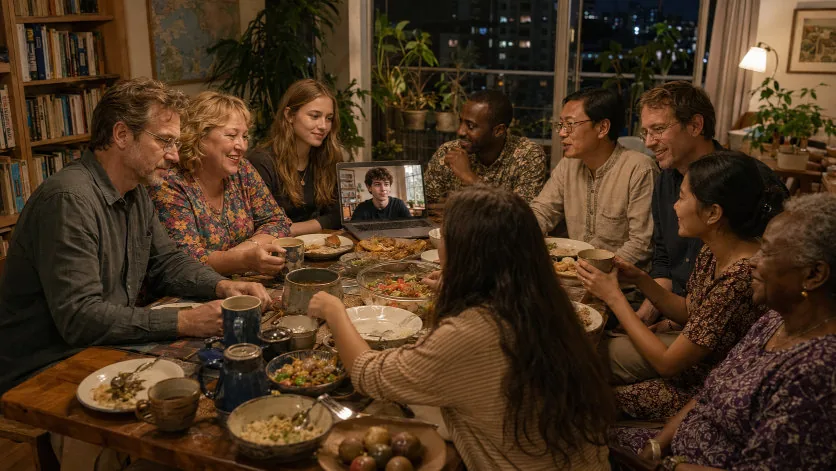
By the time Max appeared on the laptop screen, Irina had already changed the table twice.
First she moved the salad away from the open window before the insects showed interest. Then she moved Sasha's papers from the chair where a guest was supposed to sit. Then she answered a message from a driver, another from a school parent, and a third from a visiting consultant's wife who wanted to know whether a two-day safari with children was "too ambitious."
"Everything is too ambitious with children," Irina typed back. "But we will make it work."
On the laptop, Max's forehead appeared first.
"Camera," Irina said.
"This is the camera."
"Your forehead is not studying mechanical engineering at UCL."
The laptop tilted. Max was in London, in a room that looked as if several useful objects had recently collapsed onto the floor. Behind him, a kettle, a stack of notes, and something that might have been a bicycle part argued for space.
"Better?" he asked.
"Acceptable," Irina said. "Did you eat?"
"This is not a technical question."
"So no."
Anya came in still wearing the white shirt she had worn for her Model UN assembly. She had spoken that afternoon at the International School of Kenya about maternal protection: maternity care, reproductive health, safety, dignity, and what public systems reveal when women become mothers. She had been calm on stage, or at least had looked calm enough that several adults congratulated her as if calmness were the point.
At home, she dropped into a chair and looked at the laptop.
"You missed my diplomatic debut," she told Max.
"I was in a lab," he said. "We were trying to make a part fail in a controlled way. Very moving."
"Useful skill for politics," Sasha said from the kitchen doorway.
Max smiled. "See? UNEP has changed him. He makes jokes now."
Sasha carried plates to the table and gave Anya the look that meant he had something exact to say. Anya saw it coming.
"Papa, if this begins with 'on slide three,' I am leaving."
"It was a good speech."
"That is not slide three?"
"No. The slide three comment is for later."
Irina put bread on the table. "Later means tomorrow."
The Volkov family has a way of turning praise into practicalities. Somebody checks whether the claim was supported. Somebody asks whether the ending was too long. Somebody joins from another continent and complains about Wi-Fi. Affection is present, only rarely announced.
Sasha Volkov's career is the reason the family came to Nairobi. He began in Novosibirsk, in climate science and geophysics, in the world of lectures, papers, data, students, and arguments that had to survive evidence. He had the academic habit of reading a sentence as if a loose word might bring down the whole building.
That habit travelled with him.
The IPCC years came first through documents and meetings rather than through any grand decision to become international. Drafts arrived. Comments arrived. Paragraphs were reopened after everyone had thought they were finished. A sentence could take an afternoon. A phrase about confidence levels could take longer. Sasha learned that in assessment work, scientific authority had to live inside shared language.
He did not always enjoy it, but he knew how to do it without letting the science go soft.
When UNEP brought him to Nairobi as a team lead working on climate adaptation finance, the work changed again. There were fewer university corridors, more calls, more governments, more funding questions, more people trying to turn climate risk into decisions that could survive budgets. His old life had been arranged around producing knowledge. Nairobi asked what happened to that knowledge after it left the paper.
At home, Max treated this with affectionate suspicion.
Max likes things that can be built, tested, broken, improved, and built again. Mechanical engineering suits him partly because machines do not pretend to agree. If a design fails, it says so without a meeting.
He respects his father. He also enjoys needling him.
"How many people were on your call yesterday?" he asked Sasha over lunch.
"Enough."
"That means too many."
"It means enough."
"And did any physical object improve?"
Sasha passed him, through the screen, the expression he used with students who had chosen provocation as a method.
"A funding proposal improved."
"So, indirectly, a physical object may improve in three to five years."
Irina pointed the serving spoon at the laptop. "Maxim, eat something while you are being clever."
"I am in London."
"Then eat in London."
The Sasha-Max exchange usually dissolved there, with Irina returning everyone to life. Max could joke about bureaucracy; Sasha could object on principle; nobody needed to win. Five minutes later they would be discussing whether a missing screwdriver was in Nairobi, London, or lost forever in one of the family’s moves.
Irina understood this pattern better than anyone because she had spent years translating between people's official versions and their real needs.
When the family first began moving for Sasha's work, she did what had to be done. Schools, doctors, apartments, documents, relatives, guests, groceries, birthdays, transport, the invisible work of making a new city usable before anyone else could call it home. She had her own education, her own competence, and her own impatience with being treated as luggage attached to a contract. She also had a gift that became clearer with every move: people trusted her quickly.
At first, people asked for small things.
Irina, do you know a driver who will arrive at the airport on time?
Irina, where can we take my mother when she visits?
Irina, is there a guide who will not speak to us like we are idiots?
Irina, can you help with a dinner where half the guests are colleagues and half are relatives and nobody should sit next to the wrong person?
She would sigh, then smile, say "Send me the dates," and fix it.
In Nairobi, the requests found a shape. International visitors were always arriving: scientists, consultants, school families, delegations, relatives who wanted Kenya to feel real but not chaotic. Irina knew how to read a group. She knew which guest wanted luxury and which wanted a story. She knew who needed reassurance, who needed silence after a long flight, and which person in a family would later complain about the thing they said did not matter.
The tour agency grew almost before she had decided to call it that: first names in a phone, then a spreadsheet, then invoices, then clients who came back and sent their friends.. Safaris, city tours, weekend trips, airport transfers, school-family excursions, partner dinners, visiting relatives, supplier calls, hotel corrections. A business grew out of the sentence people kept saying to her: "Can you just help us with this?"
She could.
That afternoon, while Sasha tried not to discuss slide three, Irina was already arranging a short trip for a German consultant's family and answering a message from a school parent who wanted to know whether Anya's speech would be shared.
"Ask her first," Irina wrote.
Anya saw the message and groaned. "Mama."
"What? People liked it."
"You cannot send it to everyone."
"I did not say everyone."
"Your everyone and normal everyone are different."
Irina smiled, pleased rather than offended. She was a people person in a family that often pretended information was enough. She remembered who was lonely, who was new, who had a child the same age as Anya, who would enjoy a long table and who would panic at one. In another life that skill might have remained social. In Nairobi, it became infrastructure.
Anya had grown up watching all of this without calling it a lesson.
Her school life was international in the ordinary sense: accents in the hallway, parents who travelled, teachers who expected students to know too much about the world and still hand in homework on time. At home, the same world came in less polished forms. Sasha brought climate and institutions. Irina brought guests, stories, routes, small crises, and names. Max brought London and screws and sarcasm. Anya listened, objected, borrowed what she wanted, and refused what felt too much like inheritance.
The Model UN speech had been hers.
Sasha had helped only after being asked, and even then with pencil marks rather than authorship. "This claim needs a source." "This sentence is too big." "Here you can be stronger." Irina had listened once in the kitchen and stopped her halfway through.
"You are speaking as if the people in the room are examiners," she said.
"They are teachers."
"They are people first. Make them see the mother you are protecting. Then give them the policy."
Max, sent the draft at midnight London time, returned it with several adjectives removed and one comment: "Do not begin with 'throughout human history' unless you want me to report you."
Anya ignored some of them, accepted more than she would admit, and spoke well.
At lunch she rolled her eyes at the attention, but did not miss a single reaction.
"You were clear," Sasha said.
"You already said that."
"I can say it twice."
"Progress," Max said. "No charts yet."
Sasha reached for the paper beside him.
Anya stood up. "I knew it."
Irina laughed and took the paper away before he could open it. "Tomorrow."
By evening, a few friends had come by. Irina had turned Anya's speech day into something between a family meal and one of her small Nairobi gatherings. Nothing formal. Food on the table, chairs borrowed from the balcony, someone from school, someone from UNEP, a neighbour who had only meant to drop something off and stayed.
The room filled in the way Irina liked best: by accident, then by design. Sasha's colleague from UNEP found himself talking to a school parent about traffic on Mombasa Road. A consultant and his wife asked about seeing Lake Naivasha with children, and Irina gave her three options before they had finished explaining. Anya's friend came in shyly, then relaxed when Max waved from the laptop and said, "I am the decorative brother. Ignore me unless the connection fails."
Sasha moved through the room more quietly than people expected from his job title. He refilled glasses, listened to a story about a failed field trip, disappeared to answer one message, returned before Irina had to look for him. If anyone asked about UNEP, he answered. If they asked too broadly, Irina gave them a plate before he could begin at the beginning.
Max was still on the laptop, which Irina had raised on two books so he could see the table.
"You are attending as furniture," Anya told him.
"High-quality furniture."
"In IKEA flat packs," Sasha said.
Max pointed at the screen. "That was almost good."
Irina poured tea, noticed a guest looking uncertain at the food, and solved it without interrupting the conversation. She did that all evening: moved people closer, rescued a quiet student from a corner, translated one joke, ignored another, sent a driver a voice note, and still heard the moment when Anya stopped performing indifference and began to enjoy herself.
At some point, Sasha lifted his glass.
Anya gave him a warning look.
"No framework," he said.
"Good start," Max said.
Sasha looked at his daughter, then at the table Irina had somehow made larger than it was, then at the laptop where Max’s London afternoon had become part of their Nairobi evening.
"For Anya," he said. "You spoke clearly. You made people listen."
Irina raised her glass too. "And you wore the shoes I told you to wear."
Anya laughed. "That is the real achievement?"
"Obviously," Irina said. "Public life begins with comfortable shoes."
Max lifted his mug in London. "Confirmed by engineering."
For a few seconds the call froze, leaving Max with his mug in the air and an expression of grave professional authority. Everyone laughed at once, even Sasha.
When the screen came back, Max was still there.
"Did I miss the emotional part?" he asked.
"No," Irina said. "We kept it short for you."
That was the Volkovs: an international family without the brochure gloss. They had carried old habits from home, picked up new ones in every city, teased each other easily, showed up when it mattered, and built a life where each person’s work touched the others without taking over.
Sasha's career brought them into the international system. Irina made a place for them inside it. Max brought in the impatience of someone who wanted things to work, not just be discussed. Anya, for one afternoon in Nairobi, stood up and tried her own voice.
Irina was already asking who wanted cake.