Most candidates experience international recruitment one vacancy at a time.
You see a role at a UN agency, a development bank, an EU body, a climate fund, a humanitarian organisation or an international NGO. You read the requirements. You try to decide whether they are realistic for you. Then you move to the next vacancy and repeat the same exercise again.
It is exhausting, and it can distort your view. A single vacancy can feel arbitrary. A thousand vacancies start to show patterns.
dotint.careers was built partly around that premise: vacancies become more useful when they are treated as data as well as announcements.
Two insights are available to the users of dotint.careers: "Hiring Pulse" and "Your Reach". Hiring Pulse (available only to registered users of dotint.careers) is the aggregate view. It looks at which organisations are hiring, what kinds of contracts are common, where roles are located, which education levels appear often, which fields of study are requested, which languages matter, and how those patterns change over time. You can learn from it even when you are not applying to one specific job. It makes the market more legible.
Your Reach (available only to registered users of dotint.careers) brings that view closer to home. Once your profile is in the system, it compares your background with real vacancies and estimates how much of the current market is realistically within reach for you today. The question becomes more specific: which part of this vacancy market can your profile currently compete for?
International careers are often discussed in vague and discouraging terms. People say the market is competitive, political, opaque, impossible to enter, or full of hidden rules. Sometimes there is truth in that. Still, vague discouragement is hard to act on. Clearer signals are more useful.
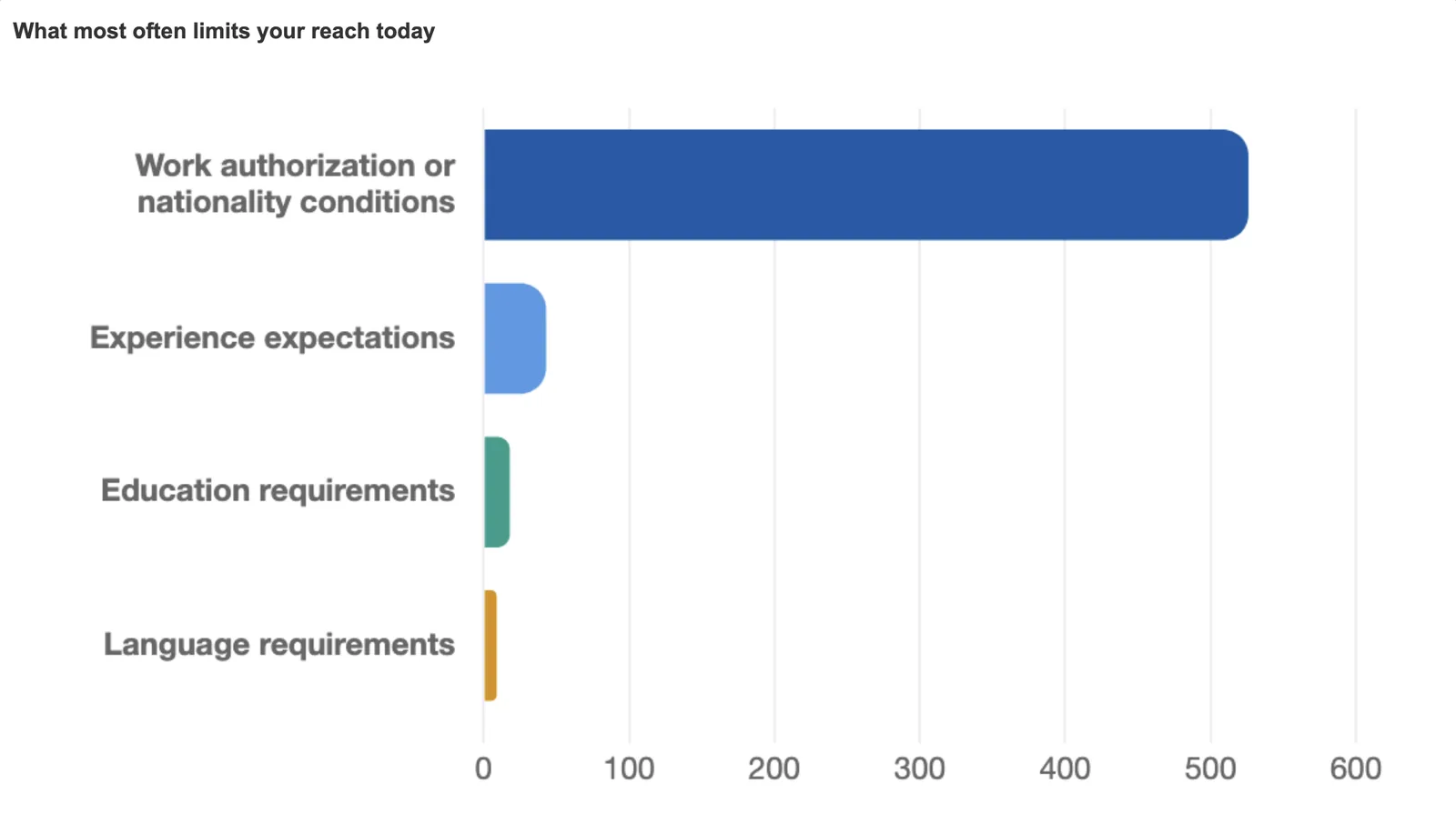
One of the most useful parts of Your Reach is the chart called "What most often limits your reach today."
The chart can feel uncomfortable. Nobody enjoys seeing education, language, experience, nationality rules or mobility preferences listed as things standing in the way. Taken properly, it summarises where the current vacancy market creates friction for your profile.
Something will always stand in the way. It helps to know what kind of barrier you are looking at, how often it appears, and whether it is worth your effort.
Profile too incomplete for initial screening
This reason is easy to misunderstand.
When it appears, the problem is usually profile completeness rather than market fit. The platform simply does not yet have enough structured information to assess your background properly.
You can usually fix this quickly. Upload or fill out your CV. Make sure your education and employment history have clear months and years. Add your languages with levels, nationality and work permits. Then use the "Review my CV" function, the profile feedback tool in dotint.careers, follow the practical suggestions, and make the final touches.
Once your profile is complete enough, this reason should stop being the main story. It is usually one of the quickest problems to clear.
Education requirements
International vacancies often ask for a specific education level. Some require a bachelor's degree. Many professional roles require a master's degree. Some technical, research, legal, medical or academic roles expect a doctorate or a very specific professional qualification.
They may also ask for particular fields of study. Commonly requested areas include international relations, public policy, law, economics, finance, business administration, project management, environmental science, climate, public health, data, IT, engineering, procurement, logistics and other specialised fields.
The signal may come from degree level, field of study, or the way your education is recorded. A degree can be present in your profile and still be hard for screening to interpret if the level, dates or field are unclear.
Compared with some other limits, education can sometimes be moved. You can earn degrees, certificates and specialised training over time. Even when you are not going back to school, the signal is still useful. It tells you what kind of educational language the market is using, and whether your profile should explain equivalent experience more clearly.
Language requirements
Nobody speaks all languages.
That sounds obvious, but it is easy to forget when looking at international vacancies. English may be enough for many roles, though far from all of them. French, Spanish, Arabic, Portuguese, Russian, Chinese and local languages can matter a lot, depending on the organisations, regions and duty stations in the current market.
If this comes up often, the current market is telling you something simple: languages are one of the filters that matter for the roles you are looking at.
Building a working professional language takes time. The signal still has value. It may tell you that improving one language would open a meaningful and additional part of the market, or that you should focus on roles where your existing languages are an advantage.
Work authorization or nationality conditions
No candidate escapes this one entirely.
Some roles are internationally recruited. Others are not. Some are local posts. Some require existing work authorization. Some are restricted to nationals of a particular country or group of countries. Some organisations are willing and able to sponsor visas. Others are not.
If your career is already established, this limitation may often appear near the top. A senior professional may be strong for many roles in substance and still be blocked by nationality, residency or work authorization rules.
You cannot have every nationality. You cannot have work authorization everywhere. And not every organisation is set up to solve that problem for every role.
Read this as a market reality rather than a personal weakness.
Experience expectations
For young professionals, this is often the most common reason.
Many international vacancies ask for three, five, seven or ten years of experience. Some ask for progressively responsible experience. Some ask for experience in a particular region, organisation type, technical area or management setting.
Experience is also one of the hardest limits to move quickly. You cannot simply rewrite two years into seven. Clearer presentation helps, but time still matters.
For early-career candidates, the practical answer is patience and better targeting. Apply to more junior roles. Look at internships (dotint.careers offers an attractive internship-only plan!), fellowships, consultancies, rosters, assistant-level posts, JPO, national officer roles, project roles and entry points that build the missing evidence.
Experience expectations become less dominant with time, but they rarely disappear entirely. At senior levels, the question often changes from "how many years?" to "what kind of experience, at what scale, in what institutional setting?"
Your stated role or contract preferences
Sometimes a vacancy falls outside your reach because of your chosen search strategy rather than your qualifications.
If you exclude certain contract types, role types or consultancy arrangements, the platform takes it quite literally: a consultancy may be an ideal role for you, but if your preferences exclude consultancies, it's out!
Preferences can quietly narrow the market. That may be exactly what you want. A narrower market can be perfectly sensible when it reflects your real priorities.
If this reason appears very often, it may be worth revisiting your settings. Perhaps your strategy has changed. Perhaps you are more open to short-term contracts than before. Perhaps consultancies are worth considering as a bridge into a new organisation. Or perhaps the chart simply confirms that your boundaries are working as intended.
Location and mobility preferences
International careers can look more mobile from the outside than they feel in real life.
A role may require relocation. It may be tied to a duty station. It may be field-based. It may be hybrid, office-based or remote only from certain countries. It may require travel, hardship duty, or presence in a region where you do not currently want or cannot easily move.
If location and mobility preferences often limit your reach, the chart is showing the tension between the vacancies available now and the life you are prepared to accept.
Not every good career move is a good life move. The chart helps you see how much your mobility choices affect the market available to you.
What is normal depends on where you are in your career
For early-career candidates, experience is often the main limit. The market is asking for evidence you are still building.
For mid-career candidates, the pattern may become more mixed. Education, language, sector fit, contract preferences and location can all matter. You may be clearly employable, but not equally suited to every part of the international market.
For senior candidates, nationality and work authorization rules, institutional background, management scale, and very specific experience expectations may become more visible. At that stage, a limitation may say as much about the narrow shape of the role as about the candidate.
For career changers, several reasons may appear at once. Someone moving from academia, government, the private sector, national NGOs or technical consulting into international organisations may face education-field questions, experience translation issues, language filters and contract uncertainty at the same time. That friction belongs to transition; it does not close the door.
Use the chart as feedback
No realistic profile clears every barrier.
The better goal is to understand what the current market is telling you. Some things can be fixed quickly: an incomplete profile, unclear dates, missing languages, outdated preferences. Some things take longer: experience, language improvement, additional qualifications, international exposure. Some things may simply be facts of your search: where you can work, what contracts you will accept, and what kind of career you actually want.
These reasons are feedback from real vacancies on your path. They show where the market is open, where it is narrow, and where your next effort may have the greatest effect.
They will also change. Your profile changes. Your preferences change. The hiring market changes. A reason that dominates today may become less important later, and a new one may appear as you move into a different stage of your career.
Something will always stand in the way. Seeing it clearly makes the next decision easier.